See how Flash Forest is accelerating reforestation across Canada. Download our latest Impact Report

Solutions
Company
Resources


501 Alliance Avenue Toronto, ON, M6N 2J1 Canada
INFO@FLASHFOREST.CA
See how Flash Forest is accelerating reforestation across Canada. Download our latest Impact Report
Project Overview
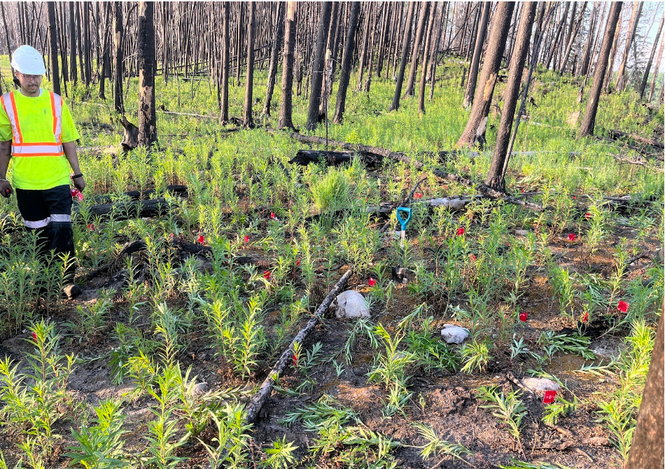
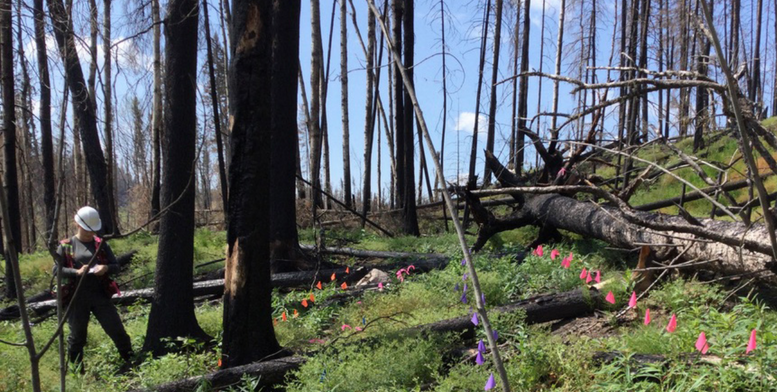
Partnered with a Northern Alberta forest products partner. The area is almost exclusively south-facing. The site consisted of sparse, heavily burned, white spruce-dominant upland forest.
Flagged Transect Summary (Permanent Plot)
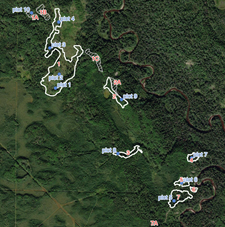
In the first year, ten plots of flagged rows were distributed across L03 with pods planted directly adjacent to flags. These permanent plots allowed us to assess early germination rates in a south-facing block, as well as test the performance of embedded vs dropped pods and the relative success of White Spruce vs Jack Pine. We used a sampling density of roughly 1 plot / 2 hectares for this site.
Circular Plot Summary (Temporary Plot)
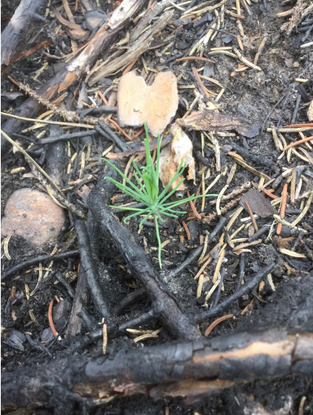
In the second year, eight circular plots were distributed at L03. These circular plots have an area of 55 m² with seedlings counted within the circle area. Before planting, the silviculture team also assessed natural regeneration and excluded sites with high regen from planting efforts to eliminate naturals from our seedling count. The only species assessed were White Spruce and Jack Pine, as those were the species the company planted. No assessment of deciduous trees was conducted, though deciduous tree growth was anecdotally observed.
Findings: Temporary Plot Assessments at Year 2
Plot # - Seedlings Counted
1 - 2
2 - 1
3 - 14
4 - 2
5 - 15+
6 - 15+
7 - 15+
8 - 1
Seedling Count for Entire Site - >27,029
Average Stems Per Hectare - >1,422
Species Mix (Year 1 permanent plots)
Jack Pine - 10%
White Spruce - 90%
Takeaways

-min.avif)


