See how Flash Forest is accelerating reforestation across Canada. Download our latest Impact Report

Solutions
Company
Resources


501 Alliance Avenue Toronto, ON, M6N 2J1 Canada
INFO@FLASHFOREST.CA
See how Flash Forest is accelerating reforestation across Canada. Download our latest Impact Report
Project Overview
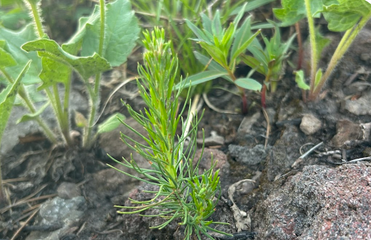
Flash Forest partnered with a private landowner on a research and development planting operation in a dry, hot Interior Douglas-fir BEC zone near Kamloops. The site was the driest and hottest of any project planted. No client was charged for this site, as it was selected to test the limits of our pod’s water retention capabilities in arid forests dominated by Ponderosa Pine.
Flagged Transect Summary (Permanent Plot)
In the first year, seven plots of flagged rows were distributed across WL0387 with pods planted directly adjacent to flags. These permanent plots allowed us to assess early germination rates in our hottest and driest region, as well as test the performance of embedded vs dropped pods and the relative success of four different species. We used a sampling density of roughly 1 plot / 1 hectare for this site.
Circular Plot Summary (Temporary Plot)
In the second year, zero circular plots were distributed at this site, due to the design of this as an R&D project and not a commercial plant. This eco-region in British Columbia has proved very challenging for manually planted seedlings, with atypically high mortality rates. Further extreme heat and lack of precipitation severly affected outcomes.
Environmental Factor - Avg Across All Sites - Avg for WL 0387
Mean Summer Precipitation (mm) - 250 - 92
Mean Summer Daily Max Temperature (°C) - 18 °C - 27 °C
Findings: Permanent Plot Assessments at Year 1 & Year 2
This data summary is distinct from most sites because no circular plots (temporary) were established here. To calculate seedling counts, the team counted seedlings at flagged transects and estimated total seedlings based on those survival rates. For example, if the flagged rows showed 5% of seedlings surviving, we assumed that held true for the rest of the site.
Flag-Transect Assessment - Seedlings (entire site)
Summer 2022 - 5,740
Fall 2022 - 2,660
Fall 2023 - 660
Average Stems Per Hectare - 132
Species Mix (Year 1 permanent plots)
Douglas Fir - 70%
Ponderosa Pine - 18%
Western Larch - 7%
Lodgepole Pine - 5%
Takeaways


-min.avif)


