See how Flash Forest is accelerating reforestation across Canada. Download our latest Impact Report

Solutions
Company
Resources


501 Alliance Avenue Toronto, ON, M6N 2J1 Canada
INFO@FLASHFOREST.CA
See how Flash Forest is accelerating reforestation across Canada. Download our latest Impact Report
Project Overview
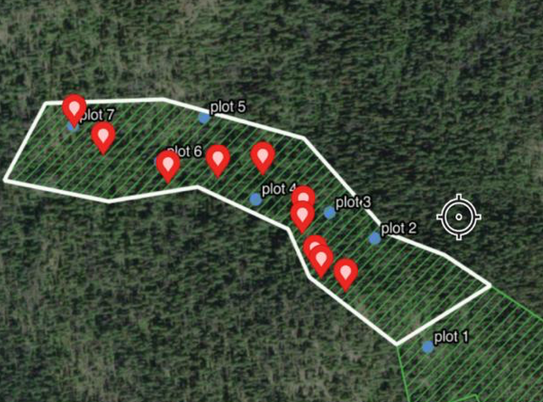
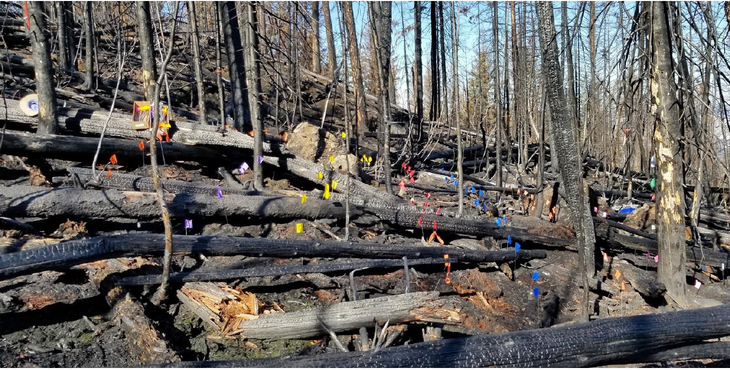
Partnered with an Indigenous band in the interior of British Columbia near 100 Mile House. The area is very hilly with a blend of south and north exposure. The site consisted of heavily burned Douglas fir and lodgepole pine.
Flagged Transect Summary (Permanent Plot)
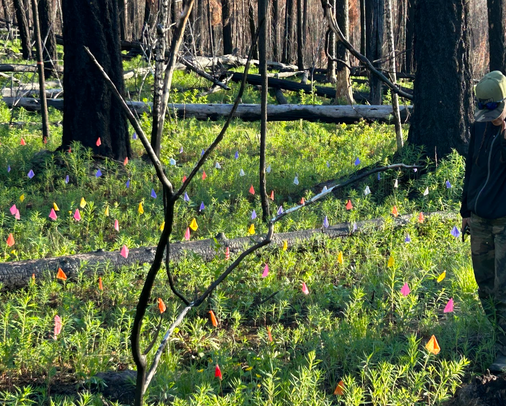
In the first year, seven plots of flagged rows were distributed across the site with pods planted directly adjacent to flags. These permanent plots allowed us to assess early germination rates and species mix before circular plots could be established. Flagged plots consist of rows of embedded pods and rows of pods dropped on the surface, to also help us account for the differences between pods that get buried and those that do not. We used a sampling density of 1 plot / hectare for this site.
Circular Plot Summary (Temporary Plot)
In the second year, ten circular plots were distributed at the site. These circular plots have an area of 55 m² with seedlings counted within the circle area. These plots follow the BC Ministry of Forests guidelines as a reliable method of predicting the average Stems per Hectare across a site.
Findings: Temporary Plot Assessments at Year 2
Plot # - Seedlings Counted
1 - 15+
2 - 11
3 - 2
4 - 5
5 - 4
6 - 11
7 - 15+
8 - 2
9 - 1
10 - 15+
Seedling Count for Entire Site - >11,390
Average Stems Per Hectare - >1,518
Species Mix (Year 1 permanent plots)
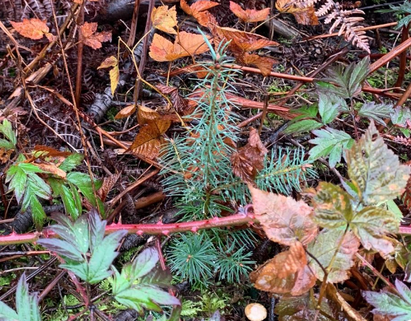
Douglas Fir - 57.8%
Hybrid Spruce - 9.5%
Western Larch - 1.5%
Lodgepole Pine - 31%
Takeaways
-min.avif)