See how Flash Forest is accelerating reforestation across Canada. Download our latest Impact Report
Bearhole Lake Aerial Seed Pod Trial
Summary
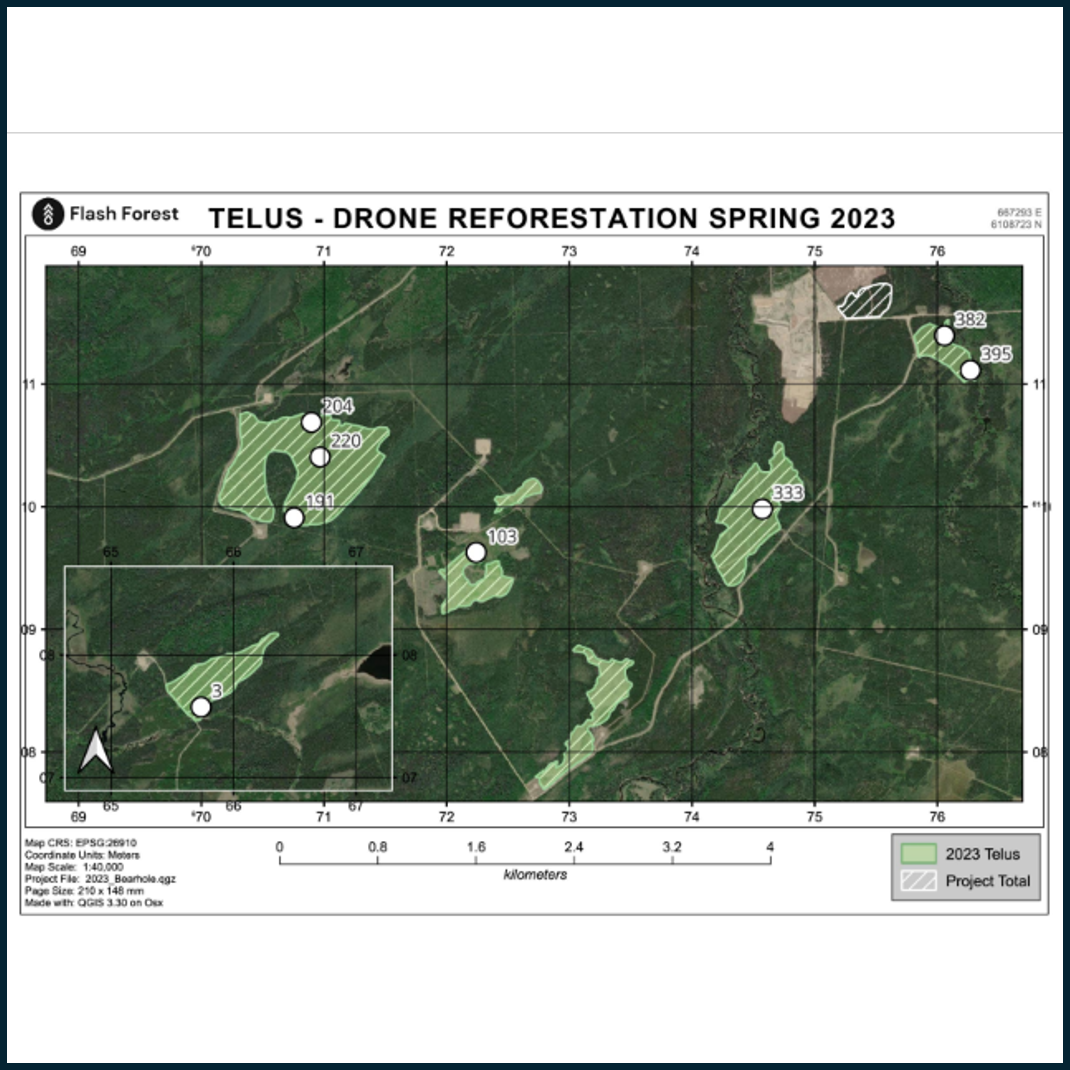
- In summer 2023, Flash Forest aerially seeded 200.4 ha of a high-severity 2022 wildfire at Bearhole Lake, BC, deploying 4,866,033 seed pods of lodgepole pine and hybrid spruce by drone.
- Two growing seasons later, a Fall 2024 assessment using circular plots and transects measured an achieved density of 14,984 SPH, roughly 10.7 times the 1,400 SPH stocking target.
- An independent field inspection by a federal government representative and RPF reached a consistent conclusion, visually estimating about 12,200 establishing seedlings per hectare.
- The inspector documented pod residue on and beside seedlings and a systematic, lineal seeding pattern matching the drone flight design, evidence of a substantial pod-origin contribution.
- The achieved density reflects both pod establishment and a degree of natural post-fire regeneration. We do not claim the full count as pod-origin; the two sources were not separated by a controlled count.
- First-season counts were assessed to genus (pine and spruce); pine seedlings were the more advanced and obvious. A Year 3 confirmation of survival and species composition is the recommended next step.
Project Details
Bearhole Lake is a mature lodgepole pine and black spruce stand in British Columbia that burned at high severity in late summer 2022. The site is well drained, with level to gently rolling topography and silty loam soils over till. The fire consumed most of the shallow organic layer and left an estimated 3,200 dead standing stems per hectare, conditions that expose abundant mineral and mineral / burnt-organic microsites suitable for conifer establishment.
Application Method
Seed pods were deployed by a rotary drone fitted with a payload designed for firing pods, applied from roughly 25 to 30 m above the forest floor at approximately 20 pods per second. Pods were distributed in a systematic pattern averaging about 57 by 57 cm (roughly three pods per square metre). The seed mix was 80% lodgepole pine and 20% hybrid spruce, both from site-suitable stratified sources. Each pod is a small biodegradable carrier, roughly 2.5 grams, that hydrates and expands in a moist or wet event to aid germination and then breaks down over the following days, leaving a grey fibrous residue that is identifiable in the field.
At the time of the aerial application, Flash Forest also installed a hand-placed control test: pods set out in two ways, on the surface of the burnt forest floor and pushed level into the soil, each marked with pin flags placed about 30 cm apart. This control allows pod-origin seedlings to be located and confirmed against known pod positions during later assessments.
Year 2 Monitoring Method
Flash Forest assessed the site in Fall 2024, the second growing season after application, using a combination of circular plots and transects across the treated area. This assessment measured an achieved density of 14,984 stems per hectare. Against the project target of 1,400 SPH, the site is stocked at roughly 10.7 times the target and is well past the threshold normally required for a fully stocked stand.
Counts reflect pine and spruce together, with lodgepole pine the more advanced and visually obvious of the two. Seedlings ranged from roughly 3 to 10 cm in height at the time of assessment and appeared generally healthy.
Independent Federal Field Inspection
On August 27, 2024, an independent field inspection was carried out by a Registered Professional Forester and a representative of the Canadian government, jointly with Flash Forest staff, including an in-house Registered Professional Forester. The inspection ran from roughly 9:30 to 14:30 and consisted of a broadcast walkabout across partitioned 4 to 5 ha portions of the site selected for relative consistency.
What the inspector observed
- Suitable establishment microsites covered more than 80% of the site, in the form of exposed mineral, mineral / burnt-organic, and mineral / club-moss seedbeds.
- Pod residue was present on and beside seedlings across all observed portions of the site.
- Seedlings followed a systematic and lineal pattern consistent with the drone flight design, with single seedlings obvious and some clumping.
- One- and two-year-old lodgepole pine and hybrid spruce were both present, pine more advanced than spruce, at roughly 3 to 10 cm in height.
- Along the hand-placed control lines, one- and two-year-old seedlings were observed adjacent to the flagged pods and distinct pod residue.
- Natural seed inputs were also active: seedling clumps where fire-deposited cone clusters had landed and some standing dead spruce carrying cones.
The inspector's estimates and conclusions
The inspector's headline estimate was approximately 12,200 establishing seedlings per hectare (older than one year) and stocking distribution on the order of 82 to 87%. These were explicitly described as visual estimates based on the walkabout, not counts from physical plots. The inspector's overall conclusion was positive: the technology delivered successful results through Year 2 at this site, with stocking close to the prescribed final distribution, and the report recommends support for the treatment on wildfire-affected sites that meet stated suitability conditions (well-drained, level to rolling, high-severity burn with most of the organic layer charred, conifer pure or mixed stands, a local or acceptable seed source, and application between about June 1 and July 15). The inspector also recommended a Year 3 final stocking inspection followed by hand fill-planting to full occupancy only if needed, and, for future deployments, a minimum of two seeds per pod, reduced pods overall and the development of formal protocols to locate pods and monitor early-life-cycle phenology.
Interpretation and Recommendations
Achieved stocking is well above target
Both the Flash Forest plot-and-transect assessment (14,984 SPH) and the independent visual inspection (about 12,200 seedlings per hectare, 82 to 87% stocking) place the site far above the 1,400 SPH target after two growing seasons.
Two independent assessments converge
The strongest signal in this trial is that two methods, run independently, agree. Flash Forest's quantitative circular plots and the federal inspector's visual field estimate both land in the same range and both far exceed target. That convergence raises confidence in the result. It is worth being clear about the differences, however: the two approaches use different methods, the inspector's figures are explicit visual estimates rather than plot counts, and the roughly 23% gap between the two numbers (14,984 versus 12,200) is consistent with that methodological difference and with normal variation across a large, partitioned site. Neither assessment separates pod-origin seedlings from natural seedlings at the species level.
Attribution: seed pods and natural regeneration
The achieved density should be read as the combined product of two sources, not of seeding alone.
- Pod-origin establishment. Pod residue found on and beside seedlings, lineal spatial pattern, the consistency of seedling age and size, and the confirmed seedlings along the flagged control lines all point to a substantial pod contribution. The independent inspector documented each of these independently.
- Natural post-fire regeneration. Lodgepole pine and black spruce are serotinous and semi-serotinous, so some natural regeneration always follows a high-severity burn, from fire-released aerial cones, ground cone caches, and ongoing seed ingress. The inspector observed seedling clumps where fire-deposited cones had fallen, so a portion of the count is unavoidably natural.
- Site selection. Areas of very low burn severity, and patches carrying a strong natural seed crop, were screened out of the seeded target area so that seeding was concentrated where natural recovery was expected to be least reliable. Even with those exclusions, a background level of natural regeneration occurs on any burn and is captured in the Year 2 counts.
The pattern, residue, and control-line evidence support a meaningful pod contribution, but the present data do not quantify the exact split.
Limitations and data-quality notes
- The achieved density blends pod-origin and natural seedlings; the two were not separated by a controlled count.
- The independent inspector's figures are visual estimates, not physical plot data.
- The deployment used one seed per pod; the inspector recommends a two-seed minimum for future sites.
- Counts are reported to genus (pine and spruce); a species-level breakdown is not included in this assessment.
Recommendations and next steps
- Carry out a Year 3 assessment to confirm survival and species composition, consistent with the inspector's recommended protocol (Year 1 is the seeding year). Given that Year 2 density already far exceeds target, fill-planting is unlikely to be required here.
- Adopt formal pod and seedling location protocols on future sites so the pod-origin and natural-regeneration components can be measured rather than estimated.
- Apply the inspector's site-suitability conditions when scoping future commercial wildfire sites, and consider the two-seed-per-pod and variable-density recommendations in deployment planning.


-min.avif)